How to Avoid High Registration Costs and Review Delays of 10DLC and A2P 10DLC?
In the startup world of 2026, if you are still sending international SMS through the US market, you have likely experienced being dominated by "10DLC (ten-digit long codes)" and "A2P 10DLC registration." Many overseas developers and SaaS startup teams often complain in forums: "Why do I have to pay hundreds of dollars in audit fees just to send a user login verification code, and wait three weeks without approval?"
With increasingly high operational costs and suffocating review cycles, how should startups "break through"?
Why is your 10DLC application always "endless"?
Under the CTIA (Cellular Telecommunications Industry Association) compliance framework, the essence of 10DLC is a "toll fee" that carriers set up to filter spam messages. For small businesses, the pain points are clear:
- High hidden costs:In addition to per-message traffic fees, there are fixed expenses for Brand Registration and Campaign Registration.
- Review black hole:After submitting materials, due to manual review backlog, Brand Vetting often gets stuck in "Manual Review" status.
- Low trust score interception:Even after approval, if your brand's Trust Score is too low, compliance won't prevent poor delivery rates.
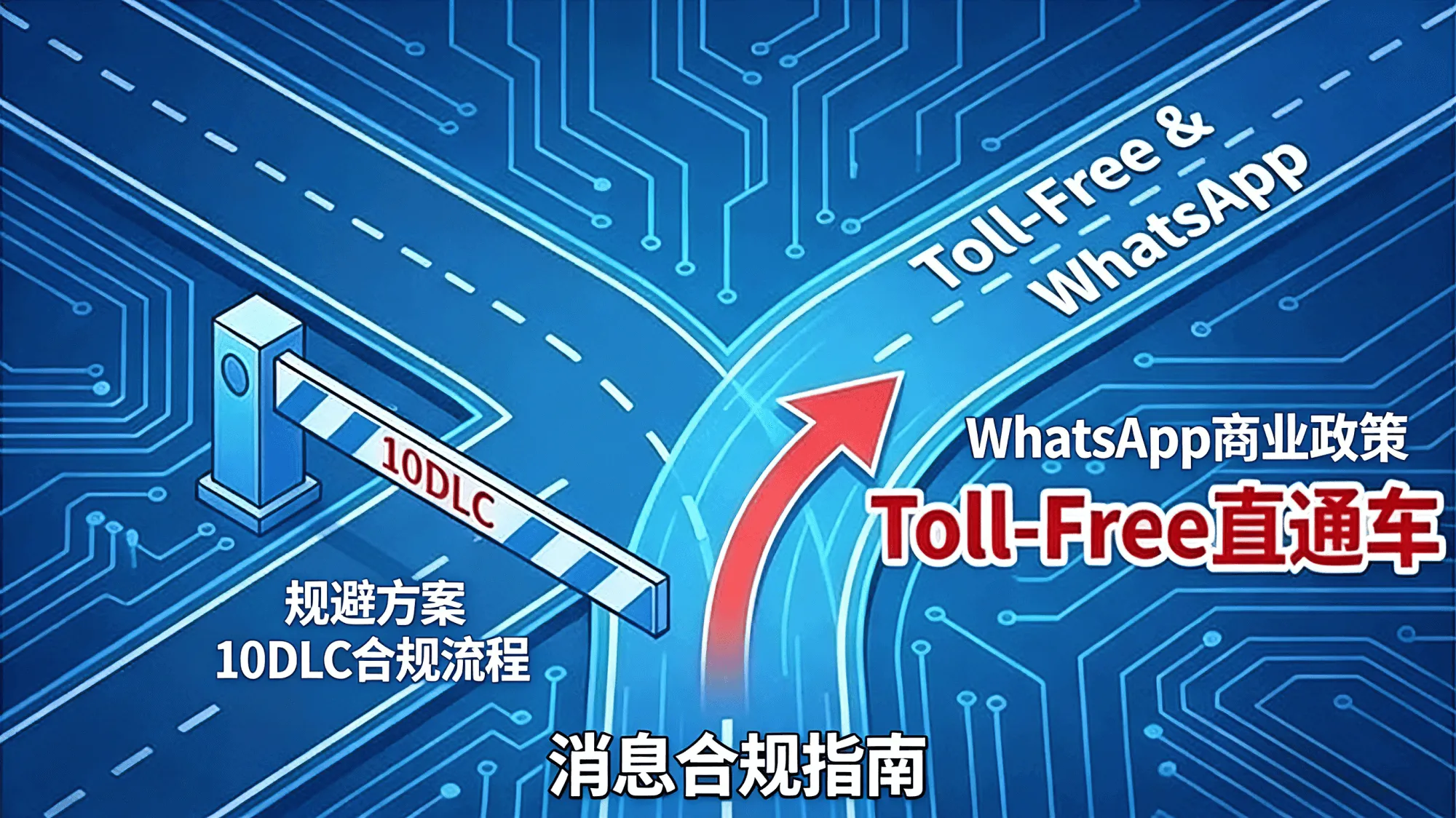
Practical Point 1: Using "Toll-Free" as a Safe Harbor During Transition
Many developers focus on 10DLC while overlooking Toll-Free (free phone numbers/800 numbers). In the 2026 compliance environment, Toll-Free has completely different review logic compared to 10DLC.
-
Strategy:For projects needing urgent launch, it is recommended to prioritize Toll-Free verification. Although it also requires Vetting, it is usually handled by a single integrator, making the process much faster than 10DLC's model requiring multiple third parties (such as The Campaign Registry).
-
Long-tail keyword application:This is exactly the roundabout solution many people search for [how to speed up 10DLC brand vetting].
Practical Point 2: Implementing "Hybrid Routing" to Reduce Dependence on High-Cost Channels
Don't put all eggs in one basket. In overseas communities, the most recommended strategy is dynamic distribution based on message types:
- Identity Verification (OTP):Use Passkeys or WhatsApp Business API.
- Emergency notifications:Reserve 10DLC or Toll-Free only for high-value information.
- Marketing information:Redirect users to email or App push.
By deploying a [reliable international SMS gateway for SaaS], you can automatically route non-core traffic to cheaper regional gateways based on each country's carrier rates and blocking strategies.
Practical Point 3: Material Pre-review and "Compliance First" Cost Reduction Plan
The core reason for 10DLC review failure is non-compliance with "privacy agreement" and "Opt-in (join) process".
-
Pitfall avoidance guide:At the bottom of your website form, you must clearly state: "Checking this box indicates agreement to receive SMS from [brand name], reply STOP to unsubscribe".
-
Professional advice:Refer to the latest [A2P 10DLC compliance guide for small business]. If you ensure your website registration and privacy policy contain clear SMS terms before submission, approval success rate can increase from 50% to over 95%, thus avoiding additional audit fees from repeated submissions.
Real Case: How One SaaS Startup Saved 60% on Communication Costs
Background:
A Singapore-based SaaS company serving North America and Southeast Asia initially relied entirely on Twilio's 10DLC channel. Due to review delays, their new user registration conversion rate dropped by 30% within a week.
Solution:
- Finding alternatives:For regions outside North America, they switched to regional providers supporting [low cost A2P SMS alternatives for startups], reducing unit price from $0.02 to $0.008.
- Bypassing deadlock:For North America, instead of stubbornly pursuing [US SMS 10DLC registration bypass] (which is almost impossible compliance-wise), they adopted "Toll-Free verification" as priority while preparing brand registration materials completely, entrusting third parties for processing, completing deployment within 5 working days.
- Result:Monthly communication costs decreased from $4800 to $1920, and verification code delay shortened from 15 seconds to within 3 seconds.
Professional Endorsement and Data Reference
According to the Mobile Ecosystem Forum (MEF) 2025 annual report, globally 22% of A2P SMS traffic is blocked due to compliance configuration errors. This means for every 5 paid SMS, 1 never reaches the user's phone.
Expert opinion:10DLC is not an obstacle but a threshold. In the AI era, carriers will only intensify their crackdown on illegal traffic. It is recommended that developers introduce "diversified authentication" solutions early in architecture design, using SMS as the last line of defense rather than the sole outlet.